Who can precept a Graceland University NP student
A Graceland University preceptor is either a nurse practitioner with at least a master's degree and a year or more in practice, or a physician who is board-certified or board-eligible. Both must be licensed, without restriction, where the site sits. Your track then narrows the field course by course, and physician assistants never qualify.
Get your placement plan
Tell us your Graceland program and where you live. A placement advisor replies with the preceptor and site options that fit your course.
Two kinds of clinician can precept you
Graceland approves two kinds of preceptor for its nurse practitioner practicums. The first is a nurse practitioner holding at least a Master of Science in Nursing from an NLNAC- or CCNE-accredited program, with at least one year of experience. An NP without a master's degree may still be considered when certified by ANCC or AANP and backed by one to three years of full-time clinical work.
The second is a physician with a medical or osteopathic degree from an accredited program who is board-certified or board-eligible. Graceland treats national certification as a given for NPs; its review list notes that "All practicing NPs are already Certified."
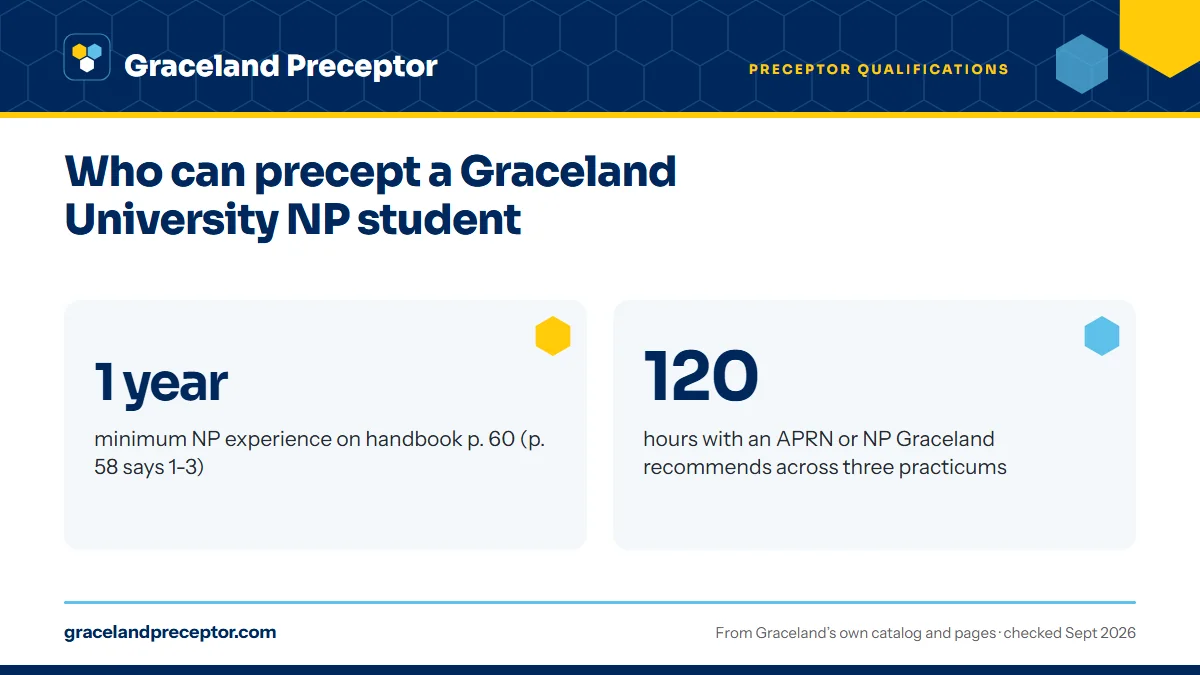
Two wrinkles matter. The 2026 Graduate Student Handbook asks for at least one year of NP experience on page 60; its review criteria on page 58 mention "1-3 years of experience in the APRN role." And the general rule describes physicians certified "in a primary care area of practice," even though the AGACNP and PMHNP sections call for hospitalists, pulmonologists, intensivists and psychiatrists. Read the general rule together with your track section, and if a candidate sits near either line, ask the course lead faculty before any paperwork is filed.
What reviewers weigh besides credentials
A contract coordinator and/or the lead faculty member for the course reviews every preceptor, and the diploma is only the start. The review also looks at how many patients the preceptor sees on a scheduled clinic or hospital day, what kind, and whether that population fits the course.
Volume matters because Graceland counts patients as well as hours, expecting one to two an hour. FNP students log as many patients as hours, so 750 patients across 750 hours, and AGACNP and PMHNP students aim for roughly 100 per practicum. A superb clinician with a thin or narrow schedule can leave you short, so ask about daily volume and patient ages before you ask about dates.
The preceptor reports license, credentials and experience on Appendix B, filed fresh for every term. The site behind them needs a signed affiliation agreement before you see a single patient there.
A license in the state where the site is
Every preceptor must hold "a current unencumbered license to practice in the state where the practicum site is located." Where the preceptor lives, or where their other clinic sits, does not change that. Where a metro area crosses a state line, as Kansas City does, check the license against the street address of your practicum.
PMHNP telehealth adds a layer: preceptor and student must both hold a license for the state each patient is in during the visit. Graceland notes that compact licenses and compact states meet that requirement.
Your side of the license rule is separate. Your own RN license has to be clear both where you live and in every approved state where you log hours, verified by the board; see RN licenses for practicums.
Iowa adds terms of its own. The Iowa Board of Nursing approves Graceland's graduate programs, and Iowa's ARNP preceptorship rule, 481 IAC 616.16, wants the preceptor licensed as an ARNP or physician by the state they practice in, employed by or under written agreement with the facility, and it wants most of your precepted time spent with someone who shares the role and population focus you are training for. See Iowa NP preceptors.
Track by track: who fits each practicum
Each NP track narrows the general rule. The table condenses the 2026 handbook's track sections; the course pages carry the full detail.
| Course | Preceptor the handbook describes | Setting limits |
|---|---|---|
NURS6740 FNP Practicum: Pediatrics | Pediatrician, pediatric NP or FNP; in family practice, one who sees 6-10 children a day | Primary care only; no specialty hours |
NURS6760 FNP Practicum: Adult | Family practice or internal medicine clinician | Primary care only; not a specialty clinic |
NURS6830 FNP Practicum: Family | Primary care clinician seeing newborns through older adults | At least half primary care; up to 150 specialty hours |
NURS5450 AGACNP Practicum: Chronic Care | Internist or hospitalist for 150+ hours and a pulmonologist for 75+ (one hospitalist who sees pulmonology patients can cover both) | Hospital, specialist office or both |
NURS5460 AGACNP Practicum: Acute Care | ICU clinician, plus up to 75 hours in one specialty | ICU |
NURS5470 AGACNP Practicum: Final | Intensivist and/or emergency department practitioner | Encouraged outside your current specialty |
NURS6841, NURS6842, NURS6843 PMHNP Practicums | Psychiatrist or certified PMHNP only | Up to 2 terms or 450 hours by telehealth |
A few limits cut across the table. AGACNP students may not see patients under 13 and may not do telehealth. FNP students may do telehealth only with the instructor's approval. And an FNP who treats mental health patients still cannot precept a PMHNP practicum. Course-level detail starts at NURS6740.
The NP hours that protect your certification
Graceland ties preceptor choice to your board exam. Citing the national task force criteria for NP education, the handbook says you need at least one documented experience with an APRN or NP during your practicums to be eligible for ANCC or AANP certification, and it recommends at least 120 hours with an APRN or NP across your three practicums.
That shapes a plan more than students expect. AGACNP practicums lean on hospitalists, pulmonologists and intensivists, roles often filled by physicians, and FNP students sometimes land a welcoming pediatrician first. A three-term plan made up only of physicians can satisfy every course rule and still miss the recommendation. Put an NP somewhere in the plan, ideally for a whole practicum.
Graceland also wants at least two different preceptors across your practicums and lets one preceptor cover at most two terms, so the NP slot is easiest to secure when all three terms are planned together. The two-preceptor rule page shows combinations that fit.
Who is ruled out however qualified
Some clinicians are off the table whatever their credentials. Physician assistants cannot precept any practicum hours. Neither can a family member, spouse, partner or significant other, anyone above or below you in a reporting line at work, or a preceptor on the unit that employs you. Who cannot precept you covers each exclusion and the gray areas around them.
Screen for these before you ask anyone. Once a preceptor has agreed and the paperwork is in, Graceland asks students not to cancel, so an exclusion discovered late is awkward for everyone. A preceptor Graceland has approved before is a good lead, and contact details for approved preceptors and sites sit in the school-selected online database, but that preceptor still files a new Appendix B for your term.
Why Graceland students have us vet their preceptors
Graceland students choose us because every preceptor we bring forward has already been checked against the rules on this page. We confirm the degree and years in practice, board status for physicians, the license state against the site's address, and the daily patient volume and age mix your course needs. For PMHNP students we confirm psychiatric certification; for AGACNP students we map the hospitalist, pulmonology, ICU and intensivist hours before the first term begins.
We also plan the NP hours your certification depends on, the second preceptor Graceland requires, and the details Appendix B asks for, so the contract coordinators receive a complete package well before Graceland's mid-June, mid-October or mid-February paperwork deadline. Graceland approves every preceptor, and we make that approval straightforward. Read how it works, then send your course and city through the form below.
Questions Graceland students ask
Can a nurse practitioner with under a year of experience precept me at Graceland?
Not under the current handbook. Page 60 sets a floor of at least one year for a master's-prepared NP, and the review criteria on page 58 mention one to three years in the APRN role. An NP comfortably past the one-year mark fits; if yours is close to the line, ask the course lead faculty before the preceptor files Appendix B.
Does a physician preceptor have to be board-certified?
Board-certified or board-eligible, with a medical or osteopathic degree from an accredited program. Eligibility is enough under the handbook's wording, which helps with physicians still completing certification. The general rule mentions a primary care area of practice, while the AGACNP and PMHNP sections name specialists, so match the physician to your track section and ask the lead faculty if unsure.
Can an FNP precept my Graceland PMHNP practicum?
No. All three PMHNP practicums must be with a psychiatrist or an NP certified as a PMHNP. The handbook states plainly that an FNP, or another NP who sees mental health patients, does not qualify. The same limit applies in the post-graduate PMHNP certificate and the PMHNP track of the BSN-to-DNP, since they share the same practicum courses.
Must my Graceland preceptor be licensed in my home state?
Only if that is where the site is. The preceptor's license has to be current and unencumbered for the state the practicum site sits in, which may differ from yours. For PMHNP telehealth, preceptor and student must both be licensed where each patient is during the visit. Your own RN license must cover your home state and every approved state where you complete practicum hours.
Is a preceptor Graceland approved before automatically cleared for my term?
No. Graceland needs a new Appendix B each term or practicum a preceptor is used, even for someone already in its database. Previously approved preceptors are still a strong place to start: the contract coordinators know them, and their site may already have an affiliation agreement on file, which can shorten the wait for your approval email.
Related pages
Last checked 2026-09-25
We check these pages against Graceland's own catalog, program pages and Graduate Student Handbook. Your handbook, your track coordinator and the contract coordinators have the final word.
Graceland's practicums are arranged by you, with Graceland's help. We do the searching.
Tell us your Graceland track, your city and your next practicum. We find preceptors who fit the course, line up what Appendix A and Appendix B ask for, and aim everything at Graceland's paperwork deadline for your term.
- Preceptors matched to the course: primary care for FNP, hospital and ICU clinicians for AGACNP, psychiatrists and PMHNPs for PMHNP
- Site address, contract contact and preceptor details ready before the June 15, October 15 or February 15 deadline
- Close to home in your approved state, with a second preceptor planned for Graceland's two-preceptor rule
Start your placement plan
Track, city and practicum start is all we need to begin.