Who cannot precept you in a Graceland University practicum
Four groups are off limits in every Graceland University NP practicum: physician assistants, relatives and romantic partners, anyone in a reporting line with you at work, and any preceptor on the unit where you are employed. The handbook states these rules in its general preceptor section and repeats them in each track, so they hold in every course.
Get your placement plan
Tell us your Graceland program and where you live. A placement advisor replies with the preceptor and site options that fit your course.
Physician assistants: not for a single hour
Graceland's wording leaves no room: "The use of physician assistants (PAs) is not allowed as a preceptor for any practicum hours." That covers all three practicums in every NP track and partial arrangements too. A PA cannot take the pediatric half of a family practice day, supervise specialty hours in NURS6830, or stand in while your NP is at a conference.
The rule bites hardest in clinics with mixed teams, where a PA, an NP and a physician share one patient panel. Your approved preceptor is the clinician named on your Appendix B, and time with anyone else outside Graceland's substitute allowance is at risk of not counting. On days when the schedule shifts, check who you are actually seeing patients with.
The same clinics can still work for you. A practice where a PA is your first contact may have a physician or NP who can precept, so a PA's introduction is worth accepting even though the PA cannot validate your time log.
Family, partners and close personal ties
Approved preceptors "must have no direct professional or personal (i.e., family member, spouse, partner, significant other) relationship to the student." The examples in the parentheses are the clear cases. A parent, sibling, spouse or partner who is an NP or physician cannot precept you, even in another state or a different specialty.
The phrase about a direct personal relationship reaches past those examples, and the handbook stops there without defining it. A close friend, a roommate or a family friend who has known you for years sits in gray territory. Graceland's reviewers make that call, so describe the connection to the contract coordinators or the course lead faculty before a preceptor fills in Appendix B.
Your personal network still matters. The handbook encourages students to ask everyone they know while searching, and that advice pays off when you use connections for introductions rather than for the preceptor role itself. The NP in your family cannot precept you; a colleague of theirs with no tie to you may be an excellent fit.
Supervisors, subordinates and your reporting line
The handbook bars a preceptor who is your "supervisor, employee, or subordinate." Earlier versions were narrower: the 2023 handbook excluded only the student's immediate supervisor at work. The current rule covers the reporting line in both directions, plus any direct professional relationship.
In practice that rules out a nurse manager or director over your unit who also holds NP credentials, a medical director who oversees your department, and anyone who reports to you. A close coworker with no formal reporting line is less clear-cut, since the words "direct professional" may reach them, so raise it with the lead faculty first. If a candidate has any say over your job, or you over theirs, look elsewhere.
Remember what a preceptor does for Graceland: validates your time logs and completes midterm and final evaluations in Typhon. Those judgments carry weight with the faculty who grade you, which is one plain reason to keep them with someone outside your chain at work.
The unit where you work
"Students may not complete their clinical experience in the same unit where they are employed." This part of the rule is about place as well as people. Even a preceptor you have never met is off limits if the practicum would happen on your own unit.
The handbook opens one door. If you work for a large healthcare system, you may complete practicum hours in a separate clinical area, away from your unit, with a preceptor who meets every other rule. An ICU nurse in the FNP track, for instance, might look to the same system's outpatient primary care clinics. Practicum at your workplace covers how students set that up and what the contract coordinators check.
Separate should mean a genuinely different clinical area with its own team and leadership. If the line is blurry, name your unit and the proposed area in your first email to the contract coordinators and let them weigh in.
Qualified clinicians who still do not fit your course
A second kind of mismatch trips up more students than the relationship rules: a fully licensed clinician whose practice does not fit the course. These are not personal exclusions, but the effect is the same, because the course lead faculty has no basis to approve them for that practicum.
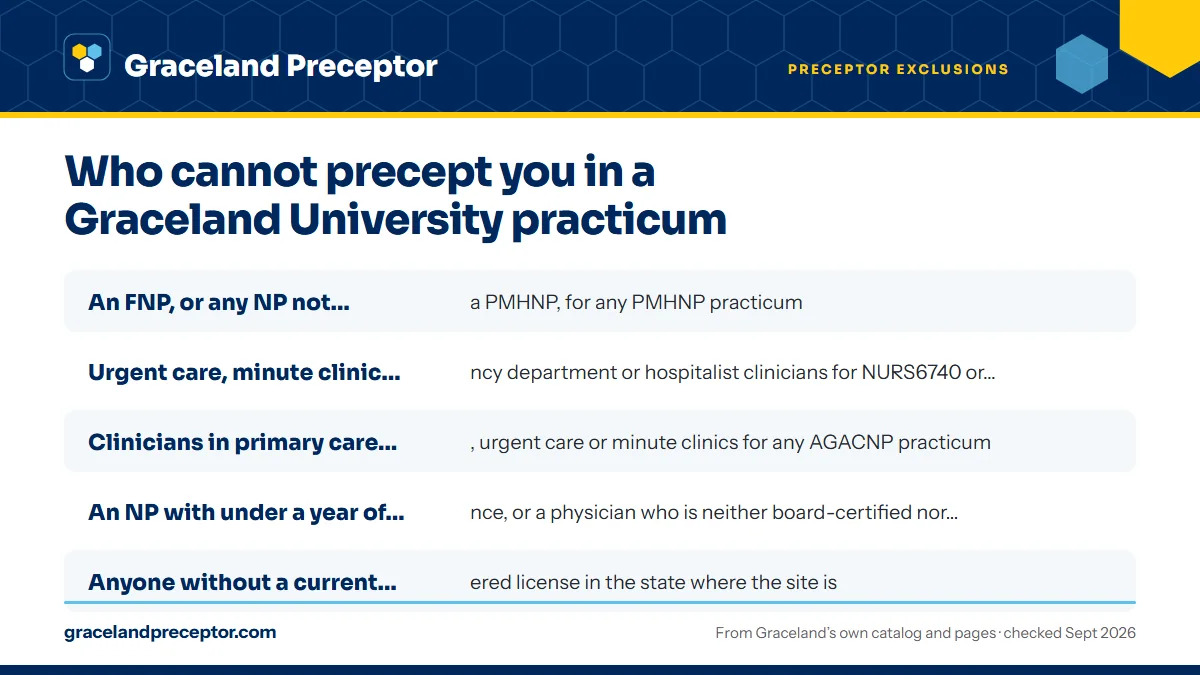
- An FNP, or any NP not certified as a PMHNP, for any PMHNP practicum
- Urgent care, minute clinic, emergency department or hospitalist clinicians for
NURS6740orNURS6760, which are primary care only - Clinicians in primary care offices, urgent care or minute clinics for any AGACNP practicum
- An NP with under a year of experience, or a physician who is neither board-certified nor board-eligible
- Anyone without a current, unencumbered license in the state where the site is
The full picture of what each course needs is on preceptor requirements.
If a conflict comes to light after approval
Sometimes a tie surfaces late: a preceptor moves into your chain of command, or a relationship begins. Tell the contract coordinators at soncontracts@graceland.edu and the course lead faculty as soon as you know. The handbook has no written procedure for this case, so they decide what happens to hours already logged and what comes next.
A replacement follows the normal route: Appendix B for the new preceptor, Appendix A if the address changes, and an approval email before hours count. Graceland asks students not to cancel a preceptor once paperwork is filed, which is exactly why screening for these exclusions early pays off. Changing or adding a preceptor walks through the steps. Keep copies of your validated time logs and any evaluation already done, so the record of hours before the change stays clean.
How we screen names before you ever ask
Graceland students choose us because we screen every candidate for these exclusions before a name reaches them. We confirm the clinician's role and certification, check that the practice fits your course, and ask the questions about reporting lines and personal ties that are easy to skip when a friendly clinic says yes. If you work for a large system, we search its separate areas and the wider community, so your options stay broad.
Every candidate comes with the details Appendix A and Appendix B ask for, ready for the contract coordinators, and with the second preceptor Graceland requires already in view. Graceland makes the final decision on every preceptor; we make sure the names you bring forward are ready for a clean review. Tell us your course and city through the contact page.
Questions Graceland students ask
Can a physician assistant cover a day when my Graceland preceptor is out?
No. Graceland does not allow PAs to precept any practicum hours, and that includes substitute days. The handbook permits one substitute per term at your primary site for up to 40 hours without new paperwork, but that substitute still has to be a qualified NP or physician. Time spent with a PA risks not counting toward your total.
Can my spouse's NP colleague precept me?
Graceland names family members, spouses, partners and significant others, plus anyone with a direct professional or personal relationship to you. A colleague of your spouse sits outside the named examples, but if you know them socially, describe the connection to the contract coordinators or lead faculty before Appendix B is filed and let them rule.
Can I do my practicum at the hospital where I work?
Yes, if the system is large enough to place you in a separate clinical area away from the unit that employs you, and the preceptor has no reporting line or personal tie to you. The site still needs its own Appendix A and affiliation agreement, and your hours count only once Graceland's approval email arrives.
Who decides whether a relationship rules a preceptor out?
A contract coordinator and/or the lead faculty for the course approve every preceptor, so they decide. The handbook names family, spouses, partners, significant others, supervisors, employees and subordinates; anything outside those examples is their judgment. Raise any doubt in writing from your Sting email before the preceptor files Appendix B, and keep the reply.
Do these exclusions apply to RN-BSN or DNP students?
The list sits in the graduate handbook's NP practicum sections. Graceland publishes no matching list for RN-BSN practice experiences or DNP practice hours, where the practice mentor's requirements are also unstated. Before choosing a mentor or site in those programs, ask your track coordinator or write to soncontracts@graceland.edu.
Related pages
Last checked 2026-09-25
We check these pages against Graceland's own catalog, program pages and Graduate Student Handbook. Your handbook, your track coordinator and the contract coordinators have the final word.
Graceland's practicums are arranged by you, with Graceland's help. We do the searching.
Tell us your Graceland track, your city and your next practicum. We find preceptors who fit the course, line up what Appendix A and Appendix B ask for, and aim everything at Graceland's paperwork deadline for your term.
- Preceptors matched to the course: primary care for FNP, hospital and ICU clinicians for AGACNP, psychiatrists and PMHNPs for PMHNP
- Site address, contract contact and preceptor details ready before the June 15, October 15 or February 15 deadline
- Close to home in your approved state, with a second preceptor planned for Graceland's two-preceptor rule
Start your placement plan
Track, city and practicum start is all we need to begin.